

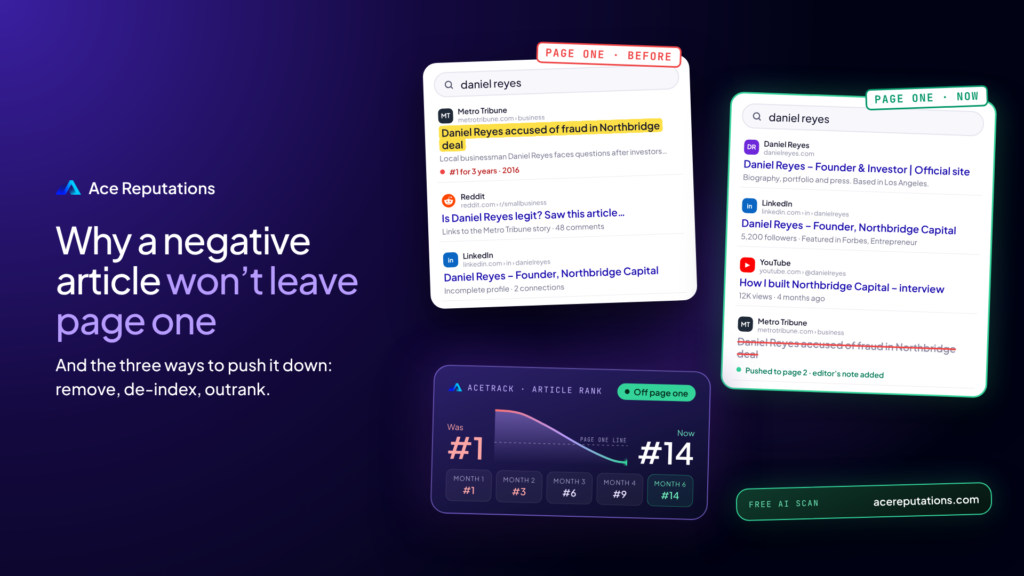
You search your name or your company, and there it is again: the same negative news article, sitting on page one months or even years after it was published. You’ve updated your website, posted on LinkedIn and asked friends to leave reviews. The article hasn’t moved.
That isn’t bad luck. Google ranks that article because, by its own measures, it’s one of the most useful results for your name. To move it, you need to understand why it ranks, then choose the right mix of removal, de-indexing and suppression.
This guide covers both. At Ace Reputations, we handle AI-driven negative content removal for individuals and businesses, and these are the same steps we take when a client asks us to clear a negative story off page one.
Why the negative article keeps ranking on page one
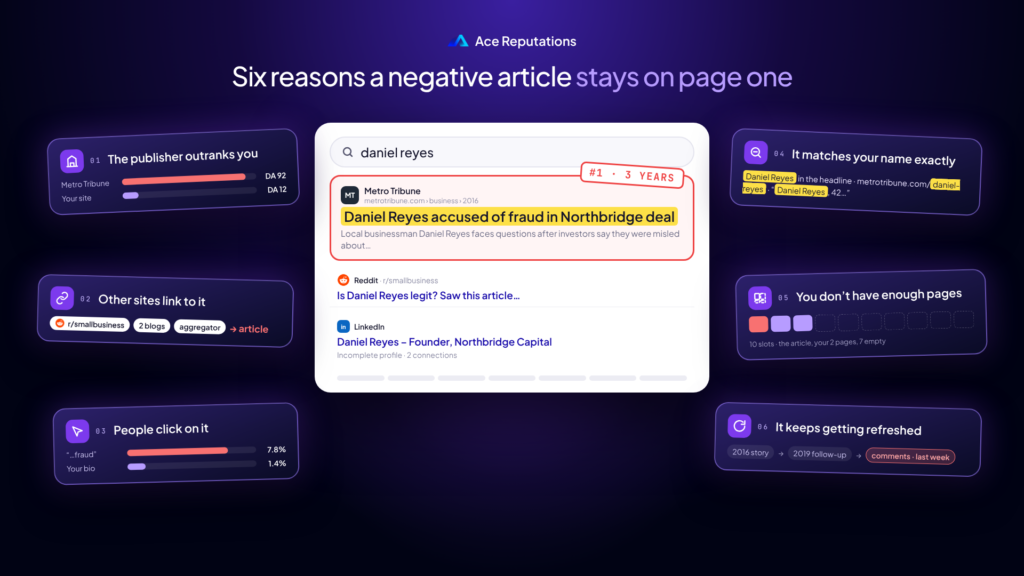
A negative article usually holds its position for several reasons at once.
1. The publisher has far more authority than you do. News sites have years of history and thousands of sites linking to them. A new page on your own website starts with almost none of that, so it can’t outrank the story on its own.
2. Other sites link to the story. Blogs, forums and aggregators often pick up a negative story and link back to it. Every link tells Google the article matters. A single Reddit thread that links to the story can keep it ranking long after the news cycle ends.
3. People click on it. When someone searches your name, a dramatic headline draws more clicks than your bio page. Engagement like this keeps reinforcing the article as a relevant result.
4. It matches your name exactly. If your full name or brand name sits in the headline, URL and first paragraph, the article lines up closely with the search query.
5. You don’t have enough strong pages of your own. Page one holds about ten organic results. If you only have a website and one or two social profiles, Google has few strong alternatives to show, so the article fills the gap.
6. The story keeps getting refreshed. Updates, follow-up pieces and new comments signal freshness, and related coverage can create a cluster of results that support each other.
Once you know which of these apply, you can choose the right fix. There are three routes, and most cases use more than one.
Option 1: Ask the publisher to update, anonymize or unpublish
The fastest permanent fix is a change at the source. If the publisher edits or removes the article, Google eventually drops or updates the result too.
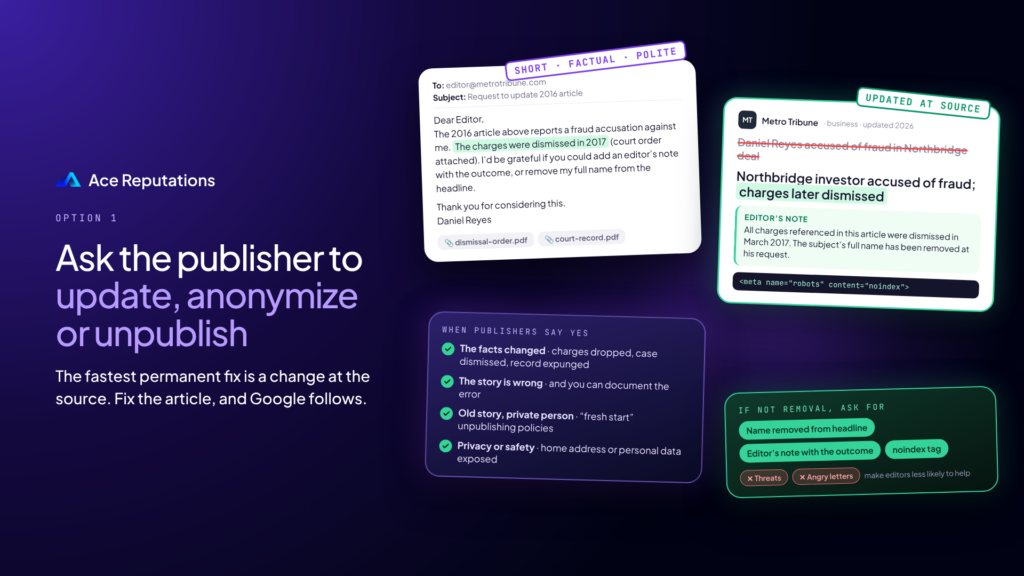
Publishers have editorial discretion and are rarely obliged to remove an accurate story. Many will still act in specific cases:
- The facts changed. Charges were dropped, a case was dismissed or a record was expunged.
- The story is factually wrong. You can document the error.
- The story is old and about a private person. A growing number of newsrooms have “unpublishing” or “fresh start” policies for minor, dated stories.
- There’s a privacy or safety issue. The article exposes personal information such as a home address.
If full removal isn’t on the table, ask for a smaller change. These often help almost as much:
- Remove or abbreviate your name in the headline and body
- Add an update or editor’s note with the outcome
- Add a noindex tag so the page stays live but drops out of search
Keep the request short, factual and polite. Include the URL, the specific change you want, and documents that support it. Avoid threats; they make editors less likely to help.
Option 2: Use legal and policy routes to de-index the article
When the publisher won’t act, you may still be able to get the URL removed from Google’s results. This is called de-indexing: the article may stay online, but people searching your name no longer find it. Our guide on how to de-index negative news articles from Google covers this in more depth.
The main routes:
- Outdated content. If the publisher has already changed or deleted the page but Google still shows the old version, Google’s Refresh Outdated Content tool can update or drop the result.
- Personal information. Google removes results that expose certain personal data, such as home addresses, phone numbers, ID numbers and some financial or medical details.
- Copyright. If the article uses your photos or other content you own without permission, a DMCA notice can remove the infringing material.
- Defamation. If a court rules that content is defamatory, Google may remove it from results based on that order. An attorney should handle this route.
- Harassment and privacy violations. Doxxing, threats and non-consensual images can be removed under platform and search engine policies.
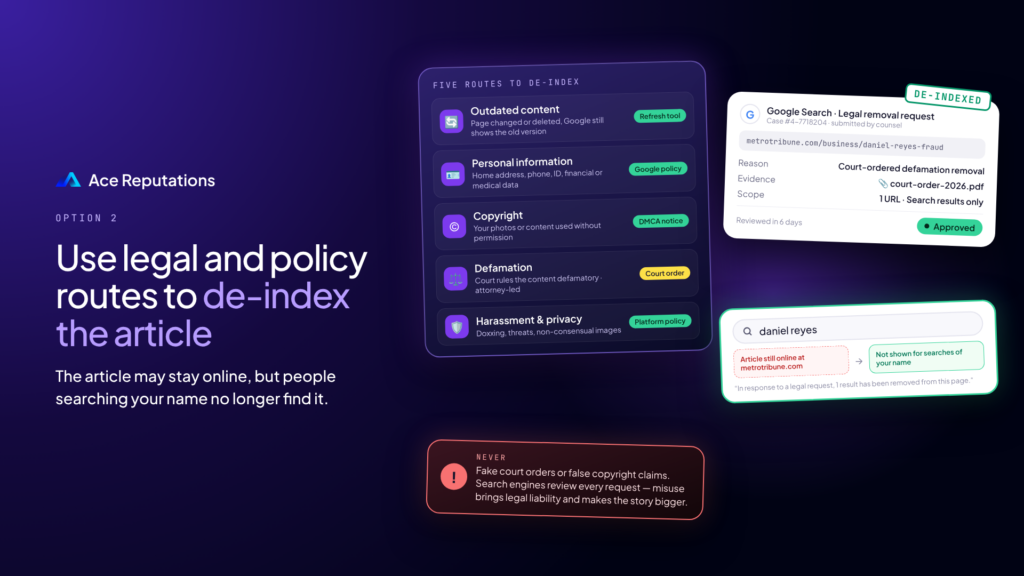
A warning: never use a fake court order or a false copyright claim. Search engines review these requests, and misuse can lead to legal liability and make the story bigger.
Option 3: Push the article down with stronger pages of your own
If the article can’t be removed or de-indexed, the goal is to fill page one with accurate, positive results so the article drops to page two. Most people never click past page one, so even a few positions can make a large difference.
The aim is not one strong page. It’s ten.
- Build a site that ranks for your name. A personal or company site with your exact name in the title, an About page and regular updates is usually the strongest result you control.
- Claim and complete high-authority profiles. LinkedIn, Crunchbase, X, Instagram, Facebook, Medium and industry directories all rank well for names. Fill every field and use the same name everywhere.
- Publish on YouTube. Video results often take their own space on page one. A short interview or explainer on a channel in your name can rank quickly. If damaging videos are part of the problem, see how to remove negative YouTube videos.
- Earn positive press. Guest articles, podcast appearances and interviews on reputable sites give you pages with the authority needed to compete with the original publisher.
- Link your assets together. Link from your website to your profiles and from profiles back to your site. This helps Google connect them to you and strengthens them as a group.
- Clean up reviews. For businesses, review pages often rank beside news results. Report fake Trustpilot reviews and misleading Google Maps reviews that break platform policies.
- Remove the supporting results. Forum threads, scraper sites and reposts that link to the story keep it strong. Removing them weakens the original article.
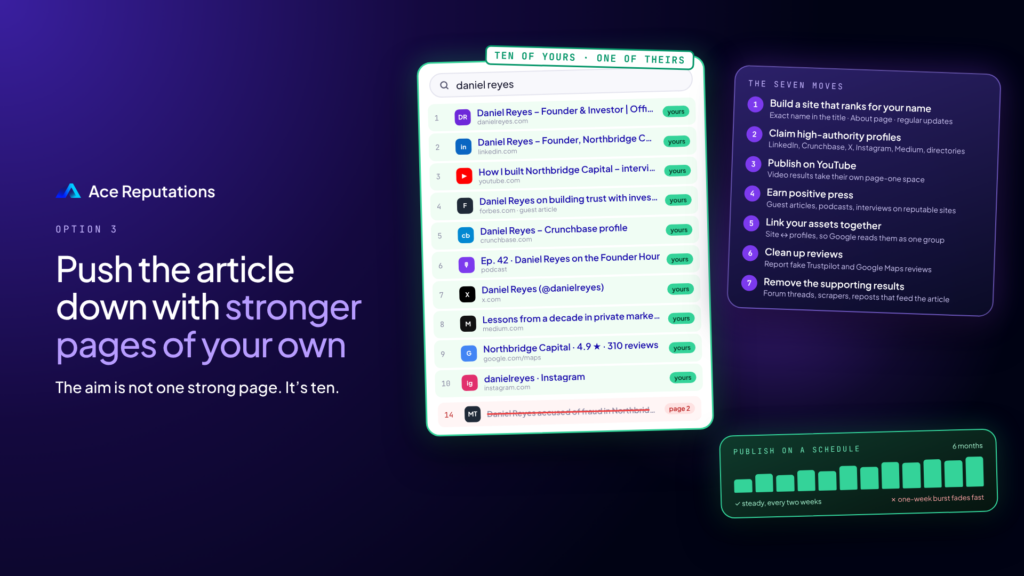
Suppression works best on a schedule. Publishing consistently over several months beats a burst of content in one week, which can look unnatural and fade quickly.
How long it takes, and what to avoid
Timelines depend on the publisher, the legal grounds and how strong the article is. As a rough guide:
| Route | Typical timeline | Result |
|---|---|---|
| Publisher update or removal | Days to weeks, if the publisher agrees | Permanent once Google re-crawls |
| De-indexing (policy or legal) | Days for policy requests; months if a court order is needed | Article gone from search, may stay online |
| Suppression | Usually 3 to 6 months or more | Article pushed to page two or lower; needs upkeep |
What to avoid:
- Responding publicly in anger. Comments, social posts or rebuttal articles can create new results and send fresh traffic to the story.
- Clicking the article over and over. Every visit from people searching your name counts as engagement.
- Cheap link schemes and fake reviews. Spammy tactics can get your own pages penalized, which leaves the article stronger.
- Ignoring AI search. AI tools often summarize the same sources Google ranks. Check what ChatGPT and AI search say about you as part of the same cleanup.
Frequently asked questions
1. *How does Ace Reputations remove negative articles from Google?*
Ace Reputations starts by reviewing the article, publisher, search visibility, legal context, and whether the content appears elsewhere online. Depending on the case, the strategy may include publisher outreach, legal or policy-based removal requests, de-indexing, corrections, or suppression using stronger authoritative content.
2. *What is AceEye™ and how does it find negative content about me or my business?*
AceEye™ is Ace Reputations’ proprietary monitoring technology used to track names, brands, keywords, articles, videos, social results, and other indexed content across search. It helps identify both obvious negative links and less-visible results that may still be affecting your online reputation.
3. *What happens if Ace Reputations cannot remove a negative article?*
If direct removal is not realistic, Ace Reputations can focus on reducing the article’s visibility through suppression, stronger owned assets, authoritative media coverage, optimized profiles, and other reputation-building strategies designed to improve what appears above the negative result.
4. *Can Ace Reputations help if I have 10, 20 or more negative articles ranking online?*
Yes. Multi-URL cases are typically approached as a broader reputation-repair campaign. Ace Reputations maps the full negative footprint, including original articles, syndications, duplicate pages, videos, social posts, and related search terms, then prioritizes each result based on its visibility, authority, and available removal or suppression options.
5. *What makes Ace Reputations different from traditional reputation management companies?*
Ace Reputations does more than publish positive content. Its approach combines reputation monitoring through AceEye™, removal and de-indexing opportunities, search suppression, authoritative media, owned assets, social and platform-specific strategies, and ongoing SERP tracking to improve the overall search landscape.
Get the article off page one
A negative article ranks on page one because Google sees it as one of the strongest results for your name. Removing it at the source, de-indexing it, or outranking it with better pages changes that. Most clients need a mix of all three, and the right mix depends on why that article ranks in the first place.
Your search results are often the first thing a client, employer or investor sees, and reputation is the new currency. Ace Reputations starts every case with a free AI scan that finds every negative result tied to your name. You choose the links you want gone, and our removal experts and legal team build the plan. There’s no upfront payment.